

If you're reading this, you probably need to purchase a gas regulator. But which one? There are many different types and they all serve a different purpose. In order to achieve the weld you desire, you have to choose the right gas regulator for your application, so we have put together this guide which explains what each type of gas regulator is for.
Single Stage Gas Regulators
As the name suggests, Single-stage welding gas regulators work in one stage to reduce the pressure leaving the cylinder through an outlet. When noting the differences between single-stage and multi-stage, it is also important to know about droop and supply pressure effects. Droop is used to describe the difference between zero pressure and the maximum amount of flow capacity in the gas regulator. Supply pressure effect, or dependency, is the variation in outlet pressure and the inlet pressure changes, or in simpler terms, occurs when the pressure changes as the cylinder empties.
Single-stage regulators are recommended for uses where there will be less fluctuation in pressure or where readjustments of pressure are not an issue.
Multi-Stage Gas Regulators
Unlike the single stage option noted above which have less droop but a greater pressure effect, multi-stage welding gas regulators show more droop but a smaller pressure effect. These multi-stage devices are also recommended for uses where pressure needs to be constantly delivered and not be adjusted.
A supply of constant pressure is one of the main advantages of using a multi-stage regulator because when gas leaves a gas cylinder, the pressure in the cylinder drops. As this happens, single-stage regulators show a ‘decaying inlet characteristic’ where the pressure increases as the inlet pressure decreases. Multi-stage regulators compensate for this by providing a constant delivery of pressure regardless of the inlet pressure.
High-Pressure Gas Regulators
Simply put, high-pressure gas regulators for welding are designed for high gas delivery rates. High-pressure regulators can be either single-stage or multi-stage and are used with equipment where a high heat output is required.
Nevoc (300 bar) Gas Regulators
Nevoc, which stands for New European Valve Outlet Connections, refers to a type of valve fitting that is designed to safely reduce the pressure from 300bar to lower levels for more efficient industrial operations.
Nevoc welding gas regulators like the Nevoc Ga600 2 Stage High-Pressure Regulator are used in instances where stable outlet pressure is required and is ideal for a variety of cutting applications like heavy machine cutting and precision cutting.
ESAB EDGE Gas Regulators
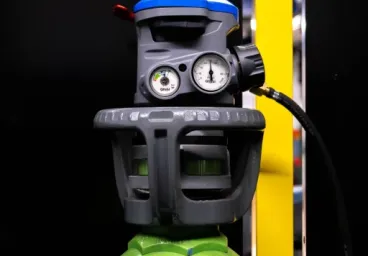
ESAB EDGE regulators come in both single and multi-stage versions for a variety of applications. They feature unique ESAB Slam technology which protects critical regulator components and the cylinder in the event of a fall, absorbing up to 5000lb of impact energy which could otherwise cause damage and potential risks with other regulators on a full gas cylinder.
ESAB EDGE also delivers better flow control and a more consistent supply of gas across a range of pressures, even when cylinder pressure decay occurs.
LPG Gas Regulators
Engweld also stocks a wide range of LPG Gas Regulators for Butane and Propane gas cylinders.