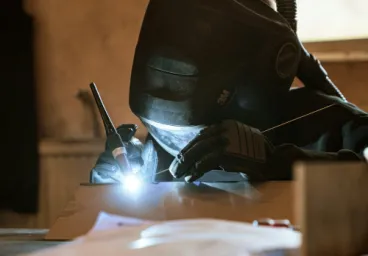


Gas welding processes, such as MIG welding and TIG welding do not use gases as fuel, unlike other welding processes, but instead, use gases to shield the weld pool from contaminants. Commonly known as shielding gases, they will be pumped through gas welding torches, where they shield the weld pool from the influence of the atmosphere.
The reason gas welding torches use shielding gas is due to the fact that both water and oxygen, can not only cause a much lower quality weld but also make the welding process less efficient and more difficult for the welder with MIG Welders for example.
Gas Welding – The Two Types of Gas
When it comes to shielding gas used in gas welding, there are two types, inert and active gases.
Inert Shielding Gases – Noble gases such as Helium and Argon are used in both MIG Welding and TIG welding, as they do not react actively in the weld pool. Other noble gases could be used in theory, but there are none that are cost-effective enough to be used commercially.
Active Shielding Gases – Otherwise known as semi-inert shielding gases, include hydrogen and carbon dioxide. Active gases can also be a mixture of inert gas and an active gas, when used correctly, using a combination of gases can bring desirable qualities. For example, an Argon and CO2 mix can increase electrical conductivity, therefore affecting the voltage and the arc and increasing penetration. while some active shielding gases can break the surface tension of the weld pool itself, which creates a flatter weld as the molten metal can flow.
MIG Welding & TIG Welding – The Gases
So we know there are two types of gas, and we know that there are 4 main gases used, but what are the positives and negatives of each?
Argon – As there are only a few gases that can be used for TIG welding projects, Argon is a highly popular choice thanks to its versatility, capable of being used to weld a wide range of metals, including mild steel, stainless steel and aluminium. It can also be used for MIG welding when working with aluminium.
Helium – Like Argon, helium is a noble, inert gas, most commonly used in the USA for TIG welding projects as it remains more expensive than Argon in Europe. When using Helium, the arc is hotter than when using Argon alone, which results in deeper penetration and a higher welding speed. Often, a Helium and Argon mix is used to great effect. However, Helium does have some downsides, notably its low density which can make it highly sensitive to air currents and thermal convection, as well as the fact it is easily ionised.
Hydrogen – While hydrogen is never used in its pure form, you will often find it mixed with other gases, namely Argon and Helium, especially when welding stainless steel, it is therefore often found in both MIG Welding and TIG welding, depending on the metal you are working with. It will increase both the voltage and the heat output, increasing both speed and penetration.
Carbon Dioxide – This is the most commonly used reactive gas used in MIG welding, and the only gas that does not need to be used in conjunction with a noble gas. Its benefits include low cost and deep penetration, but it does often produce a high spatter and a less steady arc.
And it's also really important to use the best MIG welding torches and TIG welding torches when you are welding.
Choosing the right Gas
Ultimately, the type of gas that is pumped through your gas welding torch depends almost entirely on the metal you are welding, its properties and the type of welding you are carrying out.
What works with MIG welding, may not work for TIG welding, and while some gases are effective to use with aluminium, others cannot be used. At Engweld we are providing a large range of MIG Welders and TIG Welders.
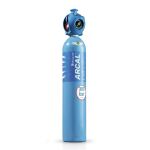
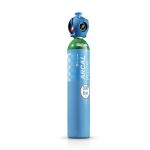
Other than welding products, we also supply a comprehensive range of cylinder gases from stock. Learn more about the different types of welding gases we offer and supply modes.
If you’d like additional information on which gas to use for MIG welding or TIG welding or to enquire about any of our gas welding products, including our gas welding torches, do not hesitate to contact us.
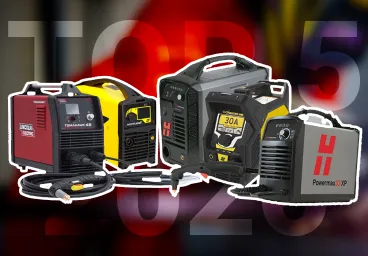
Choosing the right MIG Welder is also a very important matter while TIG Welding or MIG Welding, this is why we've ranked the best MIG welders in 2025.