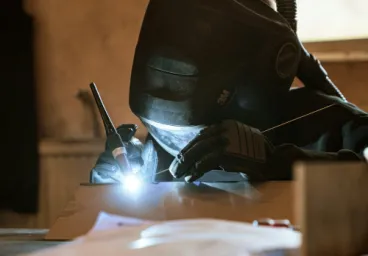


TIG (Tungsten Inert Gas) welding process stainless steel demands precise control and meticulous cleanliness to achieve high-quality welds. This process is particularly suitable for intricate designs and applications requiring exceptional aesthetic quality. Because of the control the user has over the heat input, very thin materials can be welded.
TIG Welding for Stainless Steel
TIG, also known as Gas Tungsten Arc Welding (GTAW), is a type of welding process that uses a non-consumable tungsten electrode that delivers the current to the welding arc. The tungsten and the weld puddle are protected and cooled with an inert gas. Welding stainless steel with the TIG process may be the preferred method if the application requires precision and high quality weld. The TIG welding process may be slow compared to MIG welding but it offers better control.
The TIG welding process requires more attention with good technique and steady hands which makes it more challenging than other welding processes. You have to control the amperage, the stainless steel filler metal, travel torch angle and arc length. The benefit in return is that it allows you more control over the output allowing you to make quality welds.
Factors to concider when TIG welding Stainless Steel
Choose the right filler metal
Make sure the TIG welding wire material is compatible with the type of stainless steel being welded. The TIG wires come in different diameters and the right choice will depend on the thickness of the base metal.
Common stainless steel filler materials include ER308, ER309, and ER316, depending on the specific grade of stainless steel being welded. ER308 tig welding wires can be used to weld 304 stainless steel as well as most 200 and 300 series of stainless steel. Application where the base metal properties need to be maintained and protected then ER316 is preferred choice. ER309 can be used to join stainless steel to mild steel.
Which electrode to use for Stainless Steel
Use thoriated, ceriated, or lanthanated tungsten electrodes for stainless steel welding because they offer more stable arc and can be used with higher currents than pure tungsten electrodes.
Electrodes usually have one side coloured and the colour is there to help you identify the electrode. The non-coloured side of the electrode will need to be grinded before being used.
The right TIG welding machine for Stainless Steel
Make sure you have the right settings on your TIG welding machine for stainless steel. Settings including current amperage and gas flow rate will depend on the thickness of the stainless steel.
You can pair a TIG foot pedal with your [TIG welding machine] (https://www.engweld.co.uk/category/tig-welders) and control the current with your foot as your welding.
We are providing a guide to choosing your TIG Welding machine in case you are not aware of all the parameters to bear in mind while selecting you next tig welder. And in case you want to know which are the best tig welders in 2025, we've ranked them in our last article.
Select the correct TIG Torch
ATIG welding machine usually comes with a TIG torch. The TIG torch will include a gas diffuser and collet that holds the electrode. You may want to buy a gas lens kit for your TIG torch which allows a more stable and directed gas flow making it easier to control the arc and help achieve higher quality welds.
Use the proper Shielding gas
Used for TIG welding stainless steel is usually pure argon as you can use lower flow rates allowing more stable arc and the arc voltage is somewhat less than with helium. The lower voltage is ideal for welding thin sheets and preventing burn through. Helium or mixture or mixture of argon and helium are used for welding thick stainless steel.
The technique to tig weld stainless steel
It is recommended that the torch is held at 10-15 degree angle from the workpiece. Start the welding process by striking the tungsten against the metal and then quickly retract to establish the arc. You must maintain a consistent arc length and steady speed to achieve smooth even beads.
Avoid Distortion
in TIG welding the heat you put into the base metal is manually controlled by you.
Safety Considerations for Stainless Steel TIG Welding
TIG welding generates intense UV radiation, so wearing a high-quality welding helmet with appropriate lens shading is crucial to prevent eye injuries. Ensure adequate ventilation to minimize fume inhalation. Always use appropriate PPE, including flame-resistant clothing and gloves. Be aware of electrical hazards and ensure proper grounding of equipment.